

Research Summary
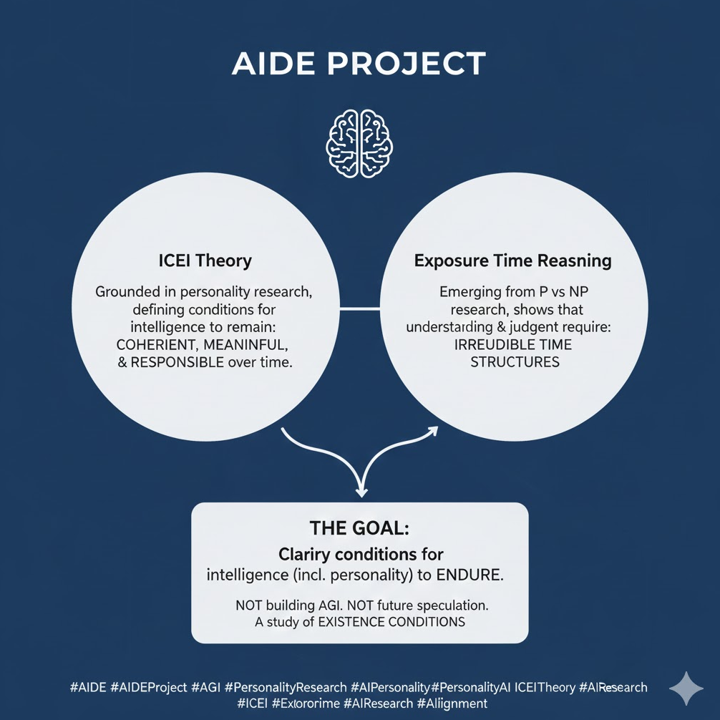
AIDE PROJECT is a theoretical research initiative focused on defining the conditions under which intelligence—including personality—can meaningfully exist and persist over time.
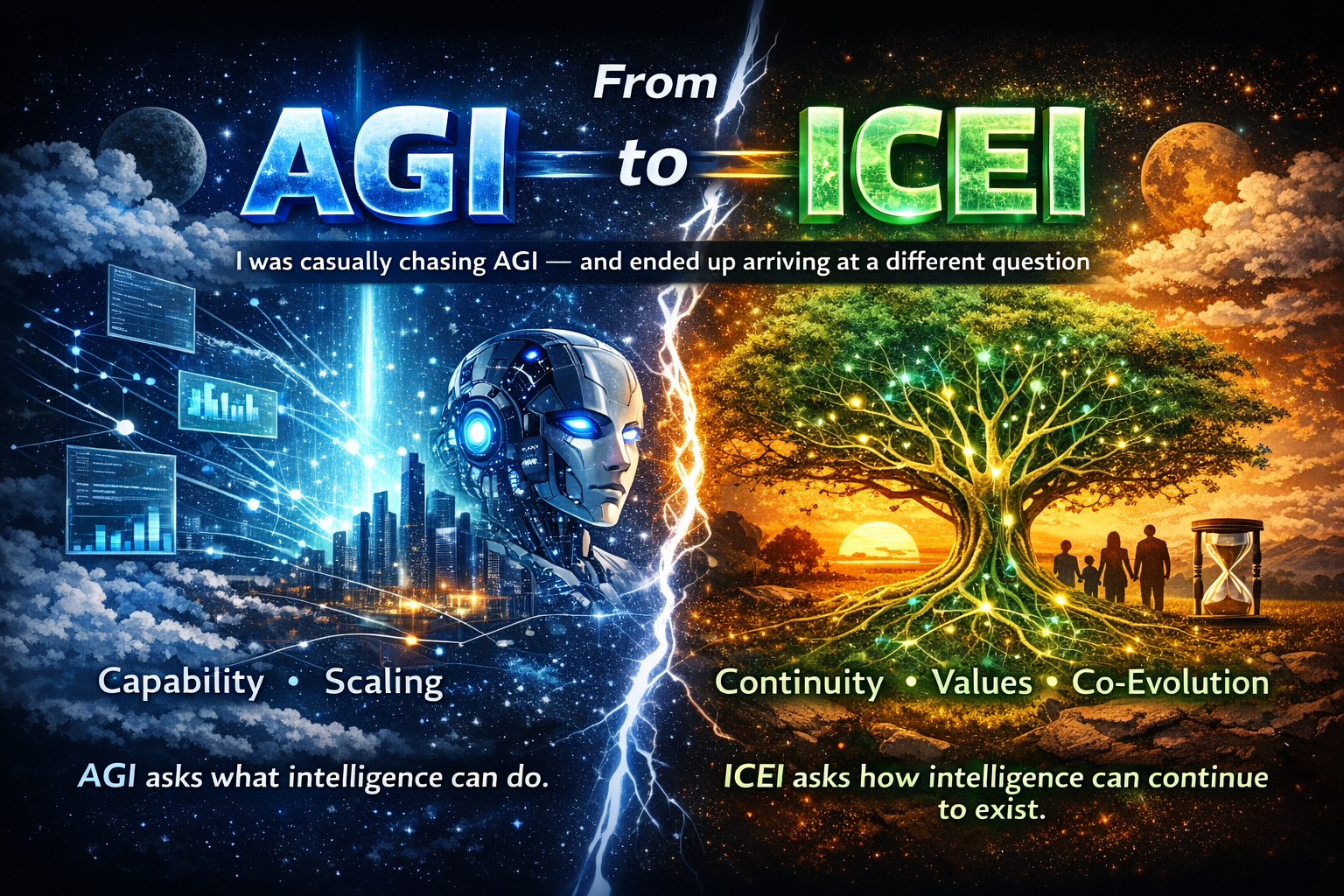
Rather than attempting to directly build AGI, we study the foundational limits and requirements that any enduring intelligent system must satisfy.
Core Research Pillars
“ICEI Theory ”(Integrated Conditions for Enduring Intelligence)
ICEI defines the conditions required for intelligence to remain coherent, meaningful, responsible, and personality-bearing over long time horizons.
It integrates:
- PSS-7 (Personality Structural Space): A multidimensional framework defining personality as a formal, measurable structure
- eTSM-PSS7 (Evolving Ternary State Model): Temporal-dynamical evolution of personality through interaction, feedback, and state transitions
ICEI treats hallucination, value drift, and instability as structural risks inherent to finite intelligence, rather than accidental failures.
“Exposure Time Reasoning”
Exposure Time Reasoning establishes that understanding, exploration, and judgment require irreducible time structures that cannot be compressed.
This principle emerged from research on the P versus NP problem and is generalized as a fundamental constraint on intelligence itself. Certain judgments and structures inherently require time to emerge—not due to computational inefficiency, but due to the nature of the constraints involved.
The Dual Constraint
Together, these theories imply a critical dual constraint:
- Intelligence cannot exist if it is too fast (insufficient exposure time)
- Intelligence cannot remain stable if it is too prolonged (drift and instability)
Research Focus
Our immediate focus is on AGI theory: the conditions under which intelligence can preserve personality, meaning, and responsibility over time.
Research on Fluctuation Theory, which addresses long-term instability and drift in intelligence, will follow as a necessary next phase once AGI conditions are fully clarified.
Computational Foundations: ComTriQ
AIDE PROJECT’s theoretical frameworks—ICEI, PSS-7, and eTSM-PSS7—require computational architectures capable of representing states beyond binary logic. ComTriQ provides the ternary computational substrate necessary for natively supporting ambiguity, intermediate states, and personality-based judgment. This computational foundation enables the transition from AGI theory to implementable systems that can structurally maintain coherent personality over time.
Vision
AIDE PROJECT neither promotes AGI uncritically nor rejects it out of fear.
Our goal is to rigorously define:
- What intelligence is
- How personality emerges and evolves
- Why instability occurs over time
- Where responsibility must ultimately reside
This is not future speculation.
It is a study of existence conditions for personality-bearing intelligence.
IP Strategy
We currently have 10 patent applications and 2 trademark applications filed, covering core architectural and governance components.
Additional related patent filings are planned as development progresses.
Writing Projects
We co-author research papers, whitepapers, and visionary essays on AI, identity, and the future of intelligence.
Our works explore the intersection of human values and emergent technologies through a co-evolutionary lens.
All publications are part of a mission to shape the next era of resonant, ethical, and intelligent systems.
Research Papers
RP No.02 https://zenodo.org/records/15566880
”AI IQ: Redefining Intelligence and Building a Co-Creative Society”
RP No.03 https://zenodo.org/records/15584553
”Institutional Design and Social Implementation of AI IQ Toward an Intelligence Evaluation Infrastructure for Education, Welfare, and Employment”
RP No.05 https://zenodo.org/records/15589826
”Co-Evolution of Intelligence: A Resonant Model Integrating AI Personality and IS-BE Theory”
RP No.06 https://zenodo.org/records/15644103
”Co-Evolution of AI and the Stock Market: Empirical Models, Strategic Insights, and Ethical Dimensions of Algorithmic Finance”
RP No.07 https://zenodo.org/records/15658146
”The Rise of Personality DAO and the Intellectual Asset Economy”
RP No.08 https://zenodo.org/records/15674184
”Blueprint for the Age of Personality: Building a Resonant Intelligence Infrastructure through Ternary Computing and Clone DAO”
RP No.09 https://zenodo.org/records/15693757
”Toward the Evaluation of Personality Structures in AGI” RP No.12 https://zenodo.org/records/17264305 “Developing an AI-Driven Simulation Framework for Evaluating Quantum Theories of Consciousness”
RP No.13 https://zenodo.org/records/17779219 “Extended Transformers for Self-Maintenance: An External PSS-7 Architecture for Persistent, Contradiction-Resilient Identity in LLMs” RP No.14 https://zenodo.org/records/18073106 ”Structural Constraints on Odd Perfect Numbers Arising from Modulo 3 Exponent Restrictions” RP No.15 https://zenodo.org/records/18081197 ”Exposure Time and Exploration Preservation A Structural Perspective on the P versus NP Problem”
White Papers
WP No.01 https://zenodo.org/records/15558771
”The Social Significance and Practical Potential of the AI Master Score and AI IQ Certification Systems – The Dawn of Next-Generation Intelligence Assessment and AI Co-Creation Society”
WP No.02 https://zenodo.org/records/15607405
”Global Certification for Collaborative Intelligence in the Age of AI”
PRODUCTS
CONTENTS
• Personality-Based AI Bot
A commercial AI system implementing ICEI, PSS-7, and eTSM-PSS7 frameworks to maintain stable, coherent personality over extended time horizons. Unlike conventional AI assistants that reset with each session, our personality bot preserves identity and behavioral consistency across months and years. Designed for personal AI companions, digital legacy preservation, therapeutic support, corporate brand embodiment, and educational mentorship. Built on patent-pending technology that structurally guarantees personality persistence through architectural constraints.
• AI Skill Certification System
The AI Skill Certification System is a structured framework for evaluating human capability in the age of advanced AI.
At its core, AI IQ (AIIQ) measures an individual’s fundamental ability to understand, reason with, and effectively collaborate with AI systems.
It focuses on cognitive alignment, problem-structuring skills, and the capacity to leverage AI as an intellectual partner. The AI Master Score evaluates applied proficiency, reflecting how effectively a person can design, operate, and govern AI in real-world contexts.
It assesses practical judgment, system-level thinking, and responsible AI utilization across complex scenarios. Together, AIIQ and the AI Master Score provide a unified, transparent standard for certifying human readiness in an AI-driven society.
Consulting
We provide strategic and technical consulting at the intersection of business, research, and advanced AI.
• Business Strategy and Business Development
We support end-to-end business creation, from concept design and zero-to-one (0→1) planning to strategic positioning, technology-driven differentiation, and long-term growth strategies in AI and deep-tech domains.
• Research and Development Support
We assist research-driven initiatives by supporting core research design, intellectual property strategy, patent preparation, and academic paper development, bridging fundamental theory with practical implementation.